
When business owners evaluate financing options, they often focus on loans, lines of credit, or investors. Yet many business-to-business companies already own an asset that can provide working capital: their unpaid invoices. Accounts receivable factoring services allow businesses to convert eligible receivables into cash rather than waiting 30, 45, or even 60 days for customers to pay. For companies managing payroll, inventory, fuel, materials, or rapid growth, factoring can improve liquidity while keeping operations moving. This article explores how accounts receivable factoring services work, who benefits most, and what businesses should look for in a long-term funding partner.
What Are Accounts Receivable Factoring Services?
Accounts receivable factoring services involve selling eligible commercial invoices to a factoring company in exchange for an advance on their value. After the customer pays the invoice, the remaining balance—less the agreed fee—is released to the business. Unlike many traditional lending products, factoring is tied primarily to the value of receivables and the credit quality of commercial customers rather than solely the borrower’s balance sheet.
Why Businesses Use Factoring
Cash flow timing is often more important than profitability. Growing companies frequently pay employees, suppliers, insurance, rent, and operating costs long before customer invoices become due. Factoring helps bridge that timing gap so management can focus on growth instead of collections.
Key Benefits
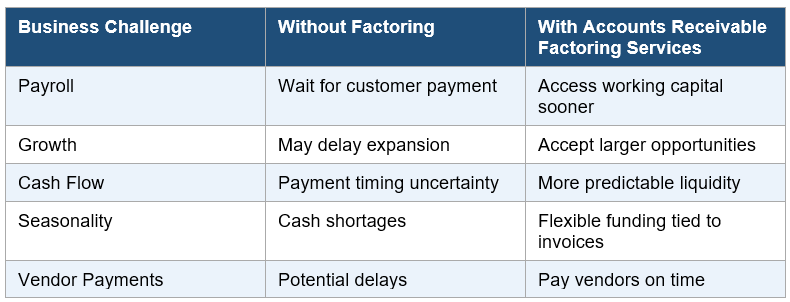
Businesses use accounts receivable factoring services for several strategic reasons. The most common advantages include:
- Faster access to working capital
- Improved payroll stability
- Greater flexibility during seasonal growth
- The ability to accept larger contracts
- Reduced dependence on bank financing
- Improved cash flow predictability
Many factoring companies also provide customer credit reviews and accounts receivable support.
Comparison Chart
Industries That Benefit
Staffing firms, manufacturers, trucking companies, distributors, oilfield service providers, janitorial companies, security firms, government contractors, wholesalers, and technology service providers commonly use factoring because they invoice commercial customers on payment terms.
How to Evaluate a Factoring Company
Choosing a factoring partner involves more than comparing rates. Businesses should review funding speed, customer service, industry expertise, contract flexibility, advance rates, reporting capabilities, transparency, and experience. A responsive partner who understands the realities of your industry can provide value beyond funding alone.
Questions to Ask
Before signing an agreement, ask:
- How quickly are invoices funded?
- What documentation is required?
- Are there minimum volume requirements?
- Are there additional fees?
- How are customer communications handled?
- What industries does the factor specialize in?
Clear answers help avoid surprises.
The Long-Term Value
The strongest companies view factoring as a working capital strategy rather than emergency financing. Predictable access to cash allows businesses to hire confidently, negotiate with vendors, invest in sales and marketing, and pursue larger customers without waiting for invoices to mature.
Conclusion
Accounts receivable factoring services have become an important financial tool for companies that sell to other businesses. By converting invoices into immediate working capital, factoring supports healthy cash flow while allowing businesses to continue growing. American Receivable Corporation has been providing owner-managed accounts receivable financing solutions since 1979, helping businesses unlock the value already sitting in their receivables. For organizations seeking dependable working capital without waiting on extended payment terms, factoring can be a practical and scalable solution.
Final Thoughts
Successful factoring relationships are built on communication, transparency, and a clear understanding of a company’s operating cycle. Businesses should regularly evaluate customer payment trends, invoice quality, and funding needs to ensure their financing strategy continues supporting long-term objectives. Whether a company is adding new customers, expanding into new markets, or simply looking for more predictable cash flow, accounts receivable factoring services can provide flexibility without requiring ownership dilution.