Running a small business requires more than a great product or service. It demands access to capital, strong cash flow management, and the ability to respond quickly to opportunities and challenges. For many entrepreneurs, one of the biggest obstacles to growth is securing the right financial solutions for small businesses.
Whether you’re launching a startup, expanding operations, hiring employees, purchasing equipment, or navigating seasonal fluctuations, choosing the right financing option can make a significant difference in your company’s long-term success.
The good news is that today’s business owners have more funding options available than ever before. From invoice factoring and business lines of credit to equipment financing and SBA loans, there are financial solutions designed to meet nearly every need.
At American Receivable Corporation, we’ve spent decades helping businesses improve cash flow and access working capital. Understanding the strengths and limitations of various financing options can help business owners make smarter financial decisions.
Why Small Businesses Need Financial Solutions
Cash flow problems remain one of the leading reasons businesses struggle. Even profitable companies can face challenges when expenses arrive before customer payments.
Common reasons businesses seek financing include:
- Covering payroll
- Purchasing inventory
- Expanding operations
- Managing seasonal slowdowns
- Funding marketing initiatives
- Buying equipment
- Hiring additional staff
- Bridging customer payment delays
The right financial solution should support growth while minimizing unnecessary risk.
Invoice Factoring: Turning Receivables into Cash
One of the most effective financial solutions for small businesses is invoice factoring.
Benefits include:
- Fast funding
- Improved cash flow
- No additional debt
- Scalable financing
- Funding based on receivables rather than business credit
Industries such as staffing, manufacturing, transportation, construction, and wholesale distribution commonly use factoring to maintain consistent cash flow.
Business Lines of Credit
A business line of credit provides flexible access to capital when needed. Similar to a credit card, companies can draw funds, repay them, and borrow again within approved limits.
Advantages include:
- Flexible borrowing
- Interest only on funds used
- Useful for short-term needs
However, qualification standards can be strict, especially for newer businesses or companies with inconsistent financial performance.
Business Credit Cards
Business credit cards remain one of the most common financial tools available.
They offer convenience, rewards programs, and immediate purchasing power.
Best uses include:
- Office supplies
- Travel expenses
- Software subscriptions
- Small emergency purchases
The downside is that high-interest rates can become expensive if balances are carried over time.
SBA Loans
The Small Business Administration supports various loan programs designed to help businesses access affordable capital.
Advantages include:
- Competitive interest rates
- Long repayment terms
- Large borrowing amounts
Challenges often include lengthy application processes, extensive documentation requirements, and slower approval timelines.
Equipment Financing
Many businesses require specialized equipment to operate efficiently.
Equipment financing allows companies to purchase machinery, vehicles, computers, or technology while spreading payments over time.
Benefits include:
- Preserves cash reserves
- Fixed repayment schedules
- Equipment often serves as collateral
This solution is especially popular among manufacturers, contractors, logistics providers, and healthcare organizations.
Merchant Cash Advances
Merchant cash advances provide funding based on future sales.
The lender advances capital and collects repayment through a percentage of future credit card transactions.
While funding is often fast, costs can be significantly higher than other financing options.
Business owners should carefully evaluate repayment terms before selecting this option.
Term Loans
Traditional term loans provide a lump sum that is repaid over a fixed schedule.
These loans may be appropriate for:
- Expansion projects
- Facility improvements
- Major purchases
- Acquisitions
Businesses with strong financial statements and established operating histories often receive the best terms.
Comparing Popular Financial Solutions
Not every financing option serves the same purpose.
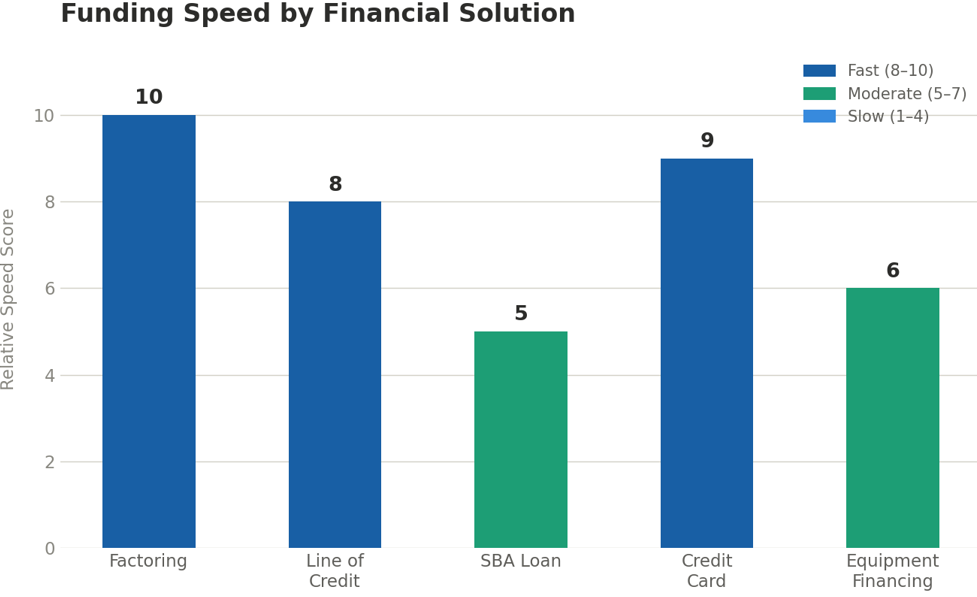
Some solutions prioritize speed. Others focus on long-term affordability. Some create debt obligations while others leverage existing assets.
The most effective funding strategy often combines multiple solutions depending on business needs.
How to Choose the Right Financial Solution
Before selecting financing, business owners should evaluate several factors.
1. Funding Purpose
What problem are you trying to solve?
A temporary cash flow gap may require a different solution than a long-term expansion project.
How quickly do you need capital?
2. Funding Speed
3. Cost of Capital
Compare total costs rather than focusing solely on rates.
The least expensive financing option isn’t always the best if it prevents growth opportunities.
4. Repayment Requirements
Understand how repayments affect cash flow.
Some solutions provide flexibility while others require fixed monthly payments.
5. Scalability
Can the financing grow alongside your business?
Many rapidly growing companies benefit from solutions that increase with sales volume.
The Importance of Cash Flow
Regardless of industry, cash flow remains the lifeblood of every small business.
Many owners focus heavily on revenue growth while overlooking working capital management.
Revenue is important.
Profit matters.
But cash flow determines whether a business can meet obligations today.
This reality explains why financial solutions for small businesses often center on improving liquidity rather than simply increasing debt.
A Real-World Scenario
Imagine a growing staffing company.
The company lands several new contracts and revenue increases dramatically. However, customers pay invoices in 45 to 60 days while employees require weekly payroll.
Without sufficient working capital, growth creates financial pressure.
Possible solutions include:
- Increasing credit card balances
- Applying for a bank loan
- Using a line of credit
- Leveraging invoice factoring
Each option carries different costs, timelines, and impacts on financial flexibility.
The best solution depends on the company’s goals, cash flow needs, and growth strategy.
Why More Businesses Are Exploring Alternative Financing
Traditional bank lending remains important, but many businesses find alternative financing solutions more accessible.
Factors driving adoption include:
- Faster approvals
- Greater flexibility
- Fewer collateral requirements
- Better scalability
- Easier qualification standards
As economic conditions evolve, small businesses increasingly seek funding solutions that can adapt quickly to changing needs.
Why Businesses Partner with American Receivable Corporation
Since 1979, American Receivable Corporation has helped businesses improve cash flow through customized invoice factoring solutions.
As an owner-managed company, ARC provides personalized service and responsive decision-making. We understand that no two businesses are identical, which is why we focus on building funding solutions that align with each client’s unique goals.
Our experience spans numerous industries, helping companies access working capital, support growth, and maintain financial stability.
Finding the right financial solutions for small businesses requires careful consideration of goals, timing, cash flow needs, and long-term strategy.
There is no one-size-fits-all answer.
Business credit cards, SBA loans, equipment financing, lines of credit, term loans, and invoice factoring each offer unique advantages.
The key is selecting solutions that strengthen cash flow, support growth, and create financial flexibility.
Chart: Relative Funding Speed by Financing Type