
The most important financing decision is not simply how to obtain capital, but how to match the source of capital to the business need. A company financing weekly payroll faces a different problem from one purchasing a building, launching a product, or surviving a temporary revenue decline. Factoring can be highly effective when cash is trapped in creditworthy accounts receivable, yet it is not automatically the best answer for every funding requirement. The appropriate choice depends on timing, purpose, repayment capacity, collateral, customer quality, ownership goals, and the company’s stage of development. A disciplined comparison can prevent a short-term cash-flow solution from becoming an expensive strategic mismatch.
Begin With the Economic Problem
Before comparing rates, management should define what the money must accomplish. Is the company funding costs already associated with completed sales, or is it financing an asset that will produce returns over several years? Is the need recurring or one-time? Is capital required in days, weeks, or months? Can the business comfortably make fixed payments if sales slow?
Factoring is designed primarily for the first situation: a business has delivered goods or services, issued valid business-to-business invoices, and must operate while customers pay on extended terms. The financing need rises and falls with receivables. A term loan, by contrast, is generally better suited to a fixed investment. Equity may be appropriate when the return is uncertain and repayment cannot begin immediately. Defining the problem first narrows the field more effectively than starting with whichever provider advertises the fastest approval.
When Factoring Is Strategically Well Matched
A business should consider factoring when it has reliable sales to creditworthy commercial or government customers but experiences pressure between invoicing and collection. Common examples include staffing companies that pay employees weekly, manufacturers that must purchase materials for new orders, transportation firms with daily fuel expenses, and service companies expanding faster than retained cash can support.
Factoring is particularly useful when funding needs grow with sales. As eligible invoice volume increases, the amount potentially available can also increase, subject to the agreement and customer limits. Because approval emphasizes the quality of receivables and the payment ability of customers, factoring may remain accessible when the seller has a limited operating history, uneven profitability, or a credit profile that makes bank financing difficult.
The strongest case exists when the gross margin comfortably absorbs the factoring cost and faster access to cash produces a measurable benefit: accepting profitable orders, avoiding payroll disruption, earning vendor discounts, or reducing operational bottlenecks.
When a Bank Line of Credit May Be Better
A bank line of credit can be a lower-cost and flexible option for an established business with strong financial statements, dependable profitability, acceptable collateral, and sufficient time to complete underwriting. Interest is generally charged on the amount borrowed, and funds can be drawn and repaid as operating needs change.
The tradeoff is qualification and structure. Banks may require covenants, borrowing-base reports, personal guarantees, periodic renewals, and evidence of debt-service capacity. A line may also be too small to support rapid growth or may be reduced if financial performance weakens. Businesses that qualify should compare a bank line with factoring on total cost, availability, reporting burden, and the likelihood that the facility will expand when sales do. Factoring can still be preferable when speed, scalability, or customer credit strength matters more than the lowest nominal rate.
Term Loans and SBA Financing
Term loans are usually appropriate for defined, long-lived investments such as equipment, vehicles, technology implementation, acquisitions, or facility improvements. The repayment schedule can be matched to the useful life of the asset. Small Business Administration-backed loans may provide favorable terms for qualifying borrowers, although applications can require substantial documentation and take longer than short-term funding alternatives.
Using factoring for a multiyear asset can create a mismatch, just as a five-year loan can outlast a routine 45-day invoice gap. The guiding principle is duration: short-term operating assets generally belong with short-term capital, while long-term assets generally belong with longer-term financing.
Merchant Cash Advances and High-Speed Online Funding
Merchant cash advances and some online business products emphasize rapid approval and minimal documentation. They can provide emergency liquidity when few options remain, but convenience may carry a high effective cost. Repayment is frequently collected through daily or weekly withdrawals or a share of card receipts, which can intensify cash pressure precisely when revenue weakens.
A business with quality receivables should compare these products carefully with factoring, which is tied to identified invoices and customer payments. Translate every proposal into total payback, payment frequency, fees, and cash remaining after deductions. Speed matters, but daily withdrawals can solve today’s shortage by creating next month’s.
Equity Capital and Investor Funding
Equity is fundamentally different because it does not create a scheduled repayment obligation. It may be suitable for a startup without receivables, a research-intensive company with a long development horizon, or a business pursuing a high-risk expansion whose returns are uncertain. Investors may also contribute expertise and connections.
The cost is ownership. Founders exchange a share of future value and may accept new governance rights, reporting expectations, or limits on control. Selling equity to cover a predictable 60-day receivable cycle can be unnecessarily expensive over the life of a successful company. When the need is temporary and invoices are eligible, factoring can preserve ownership. When there is no completed sale, no reliable repayment source, and no near-term cash flow, equity may be more realistic.
A Decision Chart for Funding Selection
The chart below summarizes the strategic fit of common funding methods. Actual pricing, approval standards, and contract terms vary by provider, so the chart should be used as a screening tool rather than a substitute for reviewing a proposal.
Funding-method comparison chart
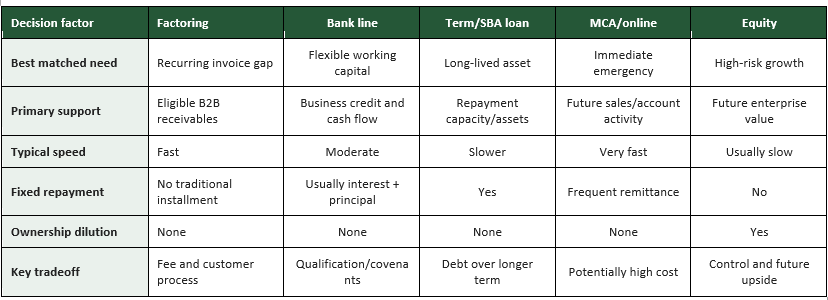
Interpretation: Relative characteristics are directional; actual terms vary by borrower and provider.
Measure the True Cost, Not Just the Rate
Funding products quote cost in different ways, which makes superficial comparisons misleading. A factoring fee may be expressed as a percentage of invoice value over a defined collection period. A loan may quote an annual interest rate plus origination and closing costs. A merchant cash advance may use a factor rate rather than an annual percentage rate. Equity has no interest rate, yet its long-term economic cost can exceed every debt alternative if the company becomes highly valuable.
Management should model at least three scenarios: expected performance, slower customer payments, and a sales decline. The analysis should calculate total dollars paid, timing of deductions, collateral exposure, required minimums, early termination costs, and the effect on available cash. It should also assign value to speed and opportunity. Paying more for capital may be rational if it enables a profitable contract that otherwise cannot be accepted, but only when the incremental profit clearly exceeds the incremental financing cost.
Operational and Relationship Considerations
Financing affects more than the balance sheet. Factoring introduces invoice verification, payment-notice procedures, and communication between the factor and customers. A professional factor should handle those interactions respectfully, while the client maintains accurate invoices and delivery records.
Bank financing may involve less customer interaction but more covenant reporting. Investors can introduce strategic oversight, while online products may require access to bank-account data. The right method should fit the company’s administrative capacity and customer relationships. Owners should ask who manages the facility, what reporting is required, and how exceptions are resolved.
Warning Signs That Factoring May Not Be the Answer
Factoring is not a cure for an unprofitable business model. If every sale loses money, accelerating collection only accelerates the cycle of loss. It may also be unsuitable when invoices are consumer-based, routinely disputed, concentrated with a financially weak customer, tied to incomplete milestones, or burdened by contractual restrictions.
Businesses should also be cautious if they need funding before any sale has occurred, require capital for a long-term asset, or cannot document that products and services were accepted. In those cases, purchase-order financing, equipment financing, a term loan, equity, or a restructuring of operations may better address the underlying need. A responsible funding decision begins by acknowledging what the chosen tool cannot fix.
A Practical Decision Framework
A business can reach a preliminary conclusion by asking five questions. Is the need created by completed, eligible invoices? Will it repeat as sales grow? How quickly must capital be available? Can the company support fixed payments during a slow period? Is preserving ownership a priority?
If the answers point to completed receivables, recurring growth, urgency, limited debt capacity, and ownership preservation, factoring deserves serious consideration. If the need concerns a durable asset and repayment can be spread across its useful life, term financing is more logical. If the company is established, bankable, and not under time pressure, a line of credit may provide economical flexibility. If no predictable repayment source exists, equity may be the more honest form of risk capital.
Choosing a Partner and Moving Forward
Once factoring appears appropriate, the next decision is provider selection. Compare advance rates, fee schedules, contract length, minimums, customer concentration limits, recourse provisions, termination requirements, funding cutoffs, and service quality. Speak with the people who will manage the account, not only the salesperson. The best agreement is one the business understands under both normal and stressful conditions.
American Receivable has provided owner-managed accounts receivable factoring since 1979. Its Dallas-based team works directly with businesses to evaluate receivables, understand operating needs, and provide responsive funding support. The central question is whether the capital fits the transaction, cash cycle, and broader objectives.
Factoring should be used when it converts sound receivables into productive working capital at a cost justified by the opportunity. Other funding methods should be chosen when their duration, repayment structure, risk allocation, or ownership implications better match the need. The most sophisticated decision is not selecting the cheapest-looking product. It is selecting the form of capital that strengthens the business after the immediate need has passed.