
For a business financing its operations through receivables, the most useful price is the one management can forecast. A headline rate may attract attention, but the financial decision depends on the cash delivered, the period funded, and the obligations attached to the transaction. Transparent factoring pricing makes those variables visible before an invoice is submitted, allowing owners to evaluate funding as an operating expense rather than an unpleasant surprise.
The distinction matters for companies whose customers pay after payroll, production, or service delivery costs are due. Factoring can accelerate cash from eligible invoices, but its value depends on whether the arrangement supports profitable activity at an understood cost. For American Receivable, a useful funding conversation begins with the business itself: its customers, receivables, margins, and working capital requirements.
The Difference Between a Rate and a Price
Factoring involves selling eligible receivables and receiving an advance against their value. When the customer pays, the factor settles the remaining reserve after applicable fees and adjustments. The advertised rate is therefore one component of a transaction that also includes an advance percentage, payment timing, and contractual terms.
A rate becomes meaningful only when its calculation is clear.
- Is the charge applied to the invoice’s face value or the amount advanced?
- Does it cover a defined period?
- Are subsequent periods charged daily, weekly, or in blocks?
Those details can change the economics even when two proposals display the same percentage.
Transparent factoring pricing translates the agreement into understandable dollars. An owner should be able to estimate the initial proceeds, expected fees, and remaining settlement for a representative invoice. Without that visibility, comparing providers becomes an exercise in comparing labels rather than financial outcomes.
Why Customer Payment Timing Changes the Calculation
A company may issue invoices on net thirty terms while customers regularly pay closer to forty five days. For financing purposes, the actual collection pattern is more useful than the printed due date. When fees depend on elapsed time, a budget built around ideal payment behavior can understate the expected expense.
Timing also has operational consequences. Delayed payments may postpone reserve releases or reduce the capacity available for additional invoices. A business with several large customers should understand how each account’s payment history influences its funding cycle.
The appropriate response is a sensitivity analysis. Estimate costs under expected payment timing, then test a slower scenario. This does not predict every outcome. It establishes a reasonable range and identifies which assumptions deserve attention. Transparent factoring pricing allows that analysis before management commits to the arrangement.
A Practical Illustration of Invoice Funding Costs
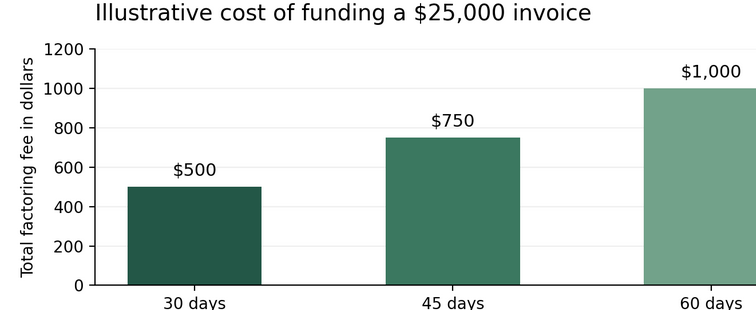
Consider a hypothetical $25,000 invoice funded at a ninety percent advance. The business receives $22,500 initially, while $2,500 remains in reserve. Assume a fee of two percent of invoice face value for the first thirty days, followed by one percent for each additional fifteen day period or portion thereof. No other charges are included in this simplified illustration.
Under these assumptions, payment at thirty days produces a $500 fee. Payment at forty five days increases the fee to $750, while payment at sixty days results in $1,000. The advance remains unchanged, but the final reserve settlement decreases as the fee increases.
Hypothetical illustration only. Not American Receivable pricing.
The chart illustrates contractual mechanics, not American Receivable’s rates or a market average. At thirty days, the $500 charge equals approximately 2.22 percent of the $22,500 advanced. That distinction between invoice value and usable cash helps explain why a quoted percentage should always be examined alongside its calculation base. This transaction ratio is not an annual percentage rate.
Advance Rates and the Availability of Cash
The advance percentage determines how much liquidity becomes available immediately. A larger advance may help cover more of a payroll cycle or production expense, but it does not independently establish whether a proposal is economical. The reserve, fees, and settlement rules must be assessed together.
A retained reserve is not automatically a fee. It is an amount withheld from the initial advance and later settled according to the agreement. Confusing reserves with costs can lead owners to overstate the expense; ignoring reserve restrictions can lead them to overstate available cash.
Management should ask when reserves become eligible for release and whether disputes, credits, or other obligations can affect settlement. Transparent factoring pricing is most valuable when the cash flow schedule is as clear as the fee schedule. Both influence the business’s ability to meet commitments.
The Contract Terms That Shape Total Cost
Additional charges can affect the final economics of a factoring relationship. Depending on the provider and agreement, these may include:
- payment transfer costs
- account administration charges
- minimum volume requirements
- termination expenses
Each should be disclosed and incorporated into a realistic comparison.
Fee triggers deserve particular attention. A small charge assessed frequently can become material over a year. Likewise, a monthly minimum can increase the effective cost during a quiet period even if the nominal invoice rate remains unchanged. Evaluate the pattern of expected use, not merely the largest projected month.
Recourse provisions also matter. The agreement should explain what happens when a customer fails to pay and how disputes or insolvency are treated. A label such as nonrecourse does not establish unlimited protection. Understanding the actual allocation of risk is essential to judging the price of the service.
Comparing Proposals on Consistent Assumptions
A useful comparison begins with the same invoices, advance needs, and customer payment assumptions for every provider. Request a written example that identifies initial funding, all applicable charges, and the expected final settlement. Then repeat the calculation using a slower collection period.
Include the costs associated with your anticipated funding frequency. A company requesting frequent transfers may have a different total expense from one consolidating its requests. Seasonal businesses should test a lower volume month as well as a busy period.
Bank financing should be considered where available, with attention to borrowing capacity, collateral requirements, and repayment obligations. Factoring serves a different structure because funding centers on eligible receivables. Transparent factoring pricing helps management compare those alternatives without assuming that speed alone justifies the expense or that the lowest advertised rate delivers the best result.
Evaluating the Return on Working Capital
The financial case for factoring depends on what accelerated cash enables.
- For a staffing agency, proceeds may support payroll tied to profitable placements.
- For a manufacturer, they may finance materials needed to complete an order.
- IT providers and oilfield service companies may face similar gaps between delivery costs and customer receipts.
The relevant comparison is between the funding expense and the expected contribution from the activity it supports. Revenue alone is insufficient. Labor, materials, overhead, and other obligations still need to be covered after the factoring fee is paid.
Owners should also consider whether earlier access to cash prevents disruptions or permits economically justified purchasing decisions. Those benefits should be estimated conservatively. Factoring cannot repair weak margins by itself, but understood funding costs can help a viable business manage the timing of profitable work.
How American Receivable Approaches Pricing Clarity
American Receivable has served small businesses since 1979, combining factoring experience with an owner managed approach. Its published program highlights include:
- no upfront fees
- no due diligence fees
These features give prospective clients concrete points to discuss when reviewing the economics of a proposed relationship.
The more important step is matching the proposal to the company’s actual receivables and operating needs. Customer quality, invoice characteristics, and anticipated payment timing should inform that conversation. A business owner benefits from knowing what applies to the account rather than relying on an advertised starting rate.
For companies evaluating transparent factoring pricing, American Receivable offers an experienced partner for that review. Prospective clients should request an explanation of the applicable fee schedule, funding process, and settlement mechanics so their decision rests on the complete arrangement.
Making Disclosure Useful After Funding Begins
Transparency should continue after the agreement is signed. Funding statements should allow the business to reconcile:
- invoices
- advances
- fees
- customer payments
- reserve activity
Regular reconciliation helps management identify discrepancies and understand whether actual costs match the original forecast.
Review customer payment trends periodically. If collections slow, update the forecast and investigate whether billing errors, missing documentation, or customer approval procedures are contributing. Accurate invoices and prompt dispute resolution can improve predictability, even when they do not guarantee faster payment.
A factoring relationship works best when pricing information supports ongoing decisions. Owners who understand their cost per funded invoice can assess customer profitability, plan cash requirements, and discuss changing needs with their factor. Clear reporting turns disclosure into a practical management tool.
A More Disciplined Funding Decision
Transparent factoring pricing gives business owners the information needed to weigh cost, liquidity, and risk together. The strongest proposal is one whose economics remain understandable under realistic payment conditions.
Contact American Receivable at americanreceivable.com to discuss your invoices and request a tailored quote. A clear explanation of the complete funding arrangement is the starting point for a sound working capital decision for your specific operating needs.