
How to compare service, contracts, funding, and fit before choosing a factor
Texas business moves fast. A staffing company can win a major contract on Monday and face a much larger payroll by Friday. A manufacturer can land a new customer and immediately need more raw materials. A transportation company may have fuel, insurance, and driver costs due weeks before its invoices are paid.
That timing gap is exactly why companies look at invoice factoring. But choosing among Texas factoring companies is not simply a matter of finding the lowest advertised rate. The real decision involves service, contract terms, industry knowledge, funding reliability, customer communication, and whether the program can support the way your business actually operates.
This buyer’s guide will help you compare providers, recognize weak offers, and know what to ask.
The Short Version
A strong factoring partner should make cash flow easier to manage—not replace one timing problem with a contract problem. Look for transparent pricing, responsive decision-makers, reasonable terms, and a clear process for approving invoices and communicating with customers.
First: What Does a Factoring Company Actually Do?
A factoring company purchases eligible business-to-business invoices. After you deliver the product or complete the service, you submit the invoice and supporting documents to the factor. Once approved, the factor advances most of the invoice value. Your customer pays the factor according to the invoice terms, and the remaining reserve is released to you after the agreed fee is deducted.
Factoring is based largely on the quality of the receivable and the creditworthiness of the customer that owes it. That can make it useful for growing companies that have solid customers but limited operating history, uneven cash flow, or a balance sheet that does not fit conventional bank underwriting.
It is not a magic fix for unprofitable work, disputed invoices, or poor documentation. The cleaner your billing process, the more smoothly a factoring program can operate.
Why the Texas Market Deserves a Closer Look
Texas is home to approximately 3.5 million small businesses, representing 99.8% of businesses in the state, according to the U.S. Small Business Administration’s 2025 profile. The Texas Comptroller also reports that businesses with fewer than 500 employees generate 40.1% of the state’s private nonfarm gross domestic product.
Those businesses span very different operating models, from staffing and manufacturing to construction, distribution, and professional services.
The point is not that every Texas company needs factoring. The point is that the state has a large, varied business base—and Texas factoring companies should understand the industries and payment patterns they claim to serve.
The Six-Part Factoring Company Scorecard
Use this scorecard to move past marketing language and compare providers on the issues that affect your day-to-day experience.
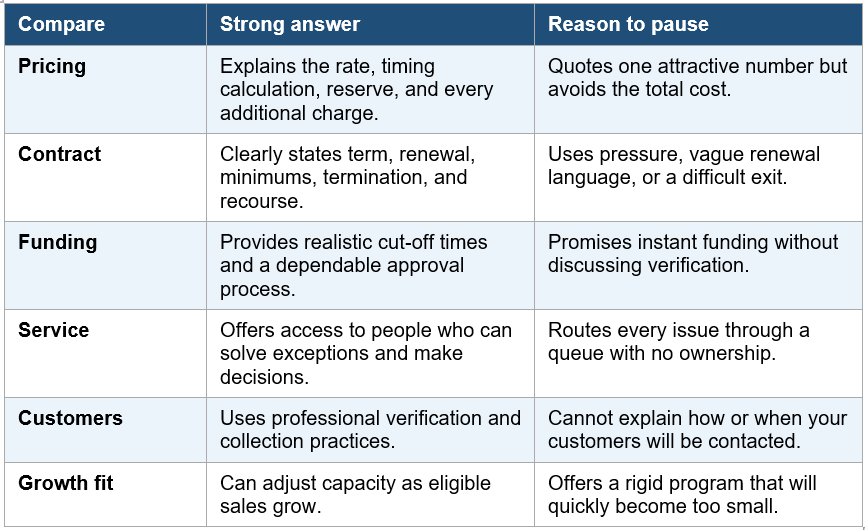
1. Compare the Total Cost, Not Just the Factoring Rate
A factoring quote may use a flat fee, a tiered fee based on time, or another structure. Ask the provider to calculate the cost on a realistic invoice using your customers’ actual payment habits. A low initial rate may become expensive if it increases every 10 days and your customers routinely pay on day 55.
Ask about due-diligence charges, transfer fees, minimums, unused-line fees, and termination costs. Know which charges apply before signing.
When comparing Texas factoring companies, request the same sample calculation from each one. An apples-to-apples example is far more useful than three proposals built around different assumptions.
2. Read the Exit Before You Enter
Contracts deserve the same attention as pricing. How long is the initial term? Does the agreement renew automatically? How much notice is required to leave? Is there a termination fee? Must you submit every invoice, or can you choose which customers or invoices to factor? Are there minimum volumes?
Review the recourse provisions as well. In a recourse program, you may need to replace or repurchase an invoice that remains unpaid beyond a stated period or becomes disputed. “Non-recourse” does not necessarily cover every reason for nonpayment; it often applies only to defined credit events. Ask for a plain-language explanation with an example.
A UCC financing statement is also common in factoring. It provides public notice of the factor’s interest in the receivables or other agreed collateral. Ask what assets the filing covers, whether another lender must subordinate its interest, and how the filing will be terminated after the relationship ends.
3. Test the Service Before You Need It
Most providers are responsive during the sales process. The better question is what happens after closing when a large invoice needs approval, a customer changes its payment process, or payroll is approaching and a verification issue appears.
Ask who handles your account, who can make funding decisions, and how exceptions are escalated. A cheaper program can feel expensive when an avoidable delay affects payroll.
Local presence is not the only measure of service, but it can be useful. Texas factoring companies that know the regional business environment may already understand common customers, industries, and payment practices. What matters most is direct access to experienced people who respond when timing matters.
4. Pay Attention to Customer Experience
Your customers will know that a factor is involved because payment instructions and verification are part of the process. That is normal. The factor’s communication style, however, becomes an extension of your own reputation.
Ask how invoices are verified, how payment reminders are delivered, and how disputes are handled. A professional factor should be persistent without being careless or needlessly aggressive. It should also know when to involve you instead of trying to resolve an operational dispute with your customer alone.
For companies with a concentrated customer base, protecting key relationships may matter as much as collection speed.
5. Match the Factor to Your Industry
Industry experience is not a decorative line on a website. It affects documentation, verification, risk assessment, and speed. A staffing factor should understand timecards, payroll cycles, and client approvals. A transportation factor should recognize bills of lading and rate confirmations. A manufacturer may need support for purchase orders, delivery documents, and customer concentration.
Ask what commonly delays funding for businesses like yours. The answer will reveal whether the provider truly understands the work. Common users of factoring in Texas include staffing, manufacturing, distribution, transportation, oilfield services, commercial services, government contracting, and other business-to-business sectors. Construction-related receivables can require additional review because of lien rights, retainage, progress billing, and contractual restrictions.
Questions to Ask Every Factoring Company
Bring these questions to every conversation and write down the answers:
- What advance rate will apply, and when is the reserve released?
- How is the factoring fee calculated on day 30, day 45, and day 60?
- Which additional fees, minimums, or volume commitments apply?
- Who approves invoices, and what documentation is required?
- What happens when an invoice is disputed or pays late?
- How will you communicate with our customers?
- What collateral will the UCC filing cover?
- How do renewal and termination work?
- Can the facility grow with our sales, and what could limit availability?
- Who will be our day-to-day contact after closing?
Red Flags Worth Slowing Down For
Pause if a provider will not give you a complete fee schedule, avoids sending the contract for review, promises approval without examining your receivables, or insists that every concern is “standard.” Standard terms still have consequences.
Other warning signs include confusing ownership, inconsistent answers, pressure to sign immediately, poor communication before closing, and a reluctance to explain customer contact. If the relationship feels difficult while the provider is trying to win your business, it is unlikely to become easier afterward.
Where American Receivable Fits
American Receivable Corporation has served businesses since 1979. Based in Dallas and owner-managed, the company provides accounts receivable factoring with direct access to experienced decision-makers. Its clients include staffing, manufacturing, distribution, service, and other business-to-business companies in Texas and across the country.
American Receivable’s approach is intentionally relationship-focused: clear communication, responsive funding, professional customer interaction, and programs designed around the operating realities of small and growing businesses. For companies comparing Texas factoring companies, that accessibility can be as important as the numbers on the proposal.
The right factor should understand where your cash-flow gap comes from and help you close it without making the process harder than it needs to be. Compare carefully, ask specific questions, and choose the partner you would still want to call on a complicated Friday afternoon—not only the one with the best-looking rate on Tuesday morning.