For many small and medium-sized businesses, maintaining healthy cash flow can be a constant challenge. Even profitable companies often struggle when customers take 30, 60, or even 90 days to pay invoices. When cash is tied up in accounts receivable, business owners may find it difficult to cover payroll, purchase inventory, accept new contracts, or invest in growth opportunities.
This is where factoring can provide a valuable solution. Factoring is a form of business funding that allows companies to convert unpaid invoices into immediate working capital. Unlike traditional loans, factoring focuses on the strength of your receivables rather than your business’s credit score or financial history.
At American Receivable Corporation (ARC), we have helped businesses improve cash flow for decades by providing fast, flexible funding solutions. In this article, we will explain what factoring is, how it works, and how it compares to other common funding options available to businesses today.
What Is Factoring?
Factoring, also known as invoice factoring or accounts receivable financing, is a financial transaction in which a business sells its outstanding invoices to a factoring company at a discount in exchange for immediate cash.
Instead of waiting weeks or months for customers to pay, the business receives most of the invoice value upfront. Once the customer pays the invoice, the remaining balance is released to the business, less the agreed-upon factoring fee.
The process is straightforward:
- Your business provides goods or services to a customer.
- You issue an invoice with payment terms.
- You submit the invoice to a factoring company.
- The factoring company advances a large percentage of the invoice value.
- Your customer pays the invoice.
- The remaining funds are released to your business after fees are deducted.
This funding model helps companies bridge cash flow gaps while continuing to grow.
Why Businesses Use Factoring
Common reasons companies choose factoring include:
- Funding payroll obligations
- Purchasing inventory and materials
- Accepting larger contracts
- Managing seasonal demand
- Improving cash flow stability
- Reducing financial stress
Industries that frequently use factoring include staffing, transportation, manufacturing, construction, oilfield services, government contractors, and distribution businesses.
How Factoring Differs from Traditional Bank Loans
One of the biggest misconceptions about factoring is that it functions like a bank loan. In reality, the two funding methods are fundamentally different.
With a traditional business loan, a company borrows money and agrees to repay the lender over time with interest. Approval is heavily based on credit scores, profitability, financial statements, collateral, and debt ratios.
Factoring, on the other hand, is not a loan. The funding is generated from the value of existing invoices. The factor evaluates the creditworthiness of your customers rather than focusing solely on your company.
As a result, businesses that may not qualify for bank financing can often secure funding through factoring.
How Factoring Compares to Business Lines of Credit
A business line of credit provides access to a predetermined borrowing limit. Companies can draw funds as needed and repay them over time.
While lines of credit can be useful, they often come with strict qualification requirements, annual reviews, financial covenants, and borrowing restrictions.
Factoring offers several advantages:
- Faster approval process
- Funding that grows alongside sales volume
- Less emphasis on business credit
- No fixed repayment schedule
- Easier access for growing companies
Many businesses find factoring more flexible because available funding increases as invoice volume increases.
How Factoring Compares to Merchant Cash Advances
Merchant cash advances provide businesses with upfront cash in exchange for a percentage of future credit card sales.
Although merchant cash advances can deliver quick funding, they often carry extremely high effective costs and daily repayment requirements.
Factoring differs because:
- Funding is based on completed invoices
- Repayment comes from customer payments
- Cash flow is not reduced by daily deductions
- Costs are generally more transparent
For companies seeking sustainable growth financing, factoring is often a more predictable solution.
How Factoring Compares to Equipment Financing
Equipment financing is designed specifically for purchasing machinery, vehicles, or equipment.
While this type of funding can be useful for asset purchases, it cannot always solve immediate working capital needs. Factoring provides unrestricted cash flow that can be used for payroll, operations, marketing, inventory, or expansion.
Many businesses actually use factoring alongside equipment financing to support overall growth.
Key Benefits of Factoring
Speed
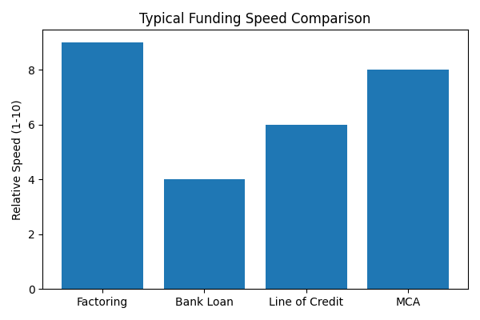
Many factoring companies can approve accounts and provide funding significantly faster than traditional lenders.
Scalability
As sales increase, available funding often increases as well. This makes factoring an attractive option for growing businesses.
Improved Cash Flow
Factoring converts slow-paying invoices into immediate working capital, helping businesses maintain healthy operations.
Credit Support
Because approval is often based on customer credit quality, newer businesses and companies with credit challenges may still qualify.
No Additional Debt
Since factoring involves selling receivables rather than borrowing money, it does not create the same type of debt obligations associated with loans.
When Is Factoring the Right Choice?
Factoring may be an excellent solution if your company:
- Issues invoices to other businesses or government agencies
- Has customers with strong payment histories
- Needs working capital quickly
- Is growing faster than cash flow allows
- Has been turned down by traditional lenders
- Wants a funding solution that scales with revenue
Businesses that consistently invoice creditworthy customers are often ideal candidates.
The Bottom Line
Unlike bank loans, lines of credit, or merchant cash advances, factoring focuses on the value of your receivables and the strength of your customers. This makes it a flexible financing solution for businesses that need fast access to cash.
Funding Speed Comparison Chart